

Navigate Texas

A student-centered approach to middle school social studies in Texas

Engage Students in Meaningful Learning

Navigate Texas encourages learners to ask questions, investigate real-world issues, and engage in meaningful experiences. The result: History, geography, civics, economics, and culture that’s relevant to them!

Much More than Learning

Navigate Texas is all about student curiosity, discovery, and connection. Through interactive tools, diverse perspectives, and real-world applications, students:

  • Build analysis, critical thinking, and collaboration skills.
  • Understand the skills of the social studies discipline.
  • Develop a deeper understanding of the world around them.
  • Take action in ways that matter to grow into informed, active citizens.

Taking Ownership

The program empowers students to take ownership of their learning in a number of ways.

  • Tier 1 Lessons give students opportunities to communicate and act on their new learning through Show What You Know.
  • Active Learning Lessons invite students to build 21st century skills: collaboration, communication, critical thinking, and creativity.
  • The Video Library allows students to dig deeper into content at their own pace and in line with their interests and needs.
  • Skill Builder Chats help students be ready for social studies by walking them through the skills of the discipline.
Navigate Texas Program Example

A Holistic Approach

The program is designed to support all learners at every stage of their learning. The ultimate goal is student mastery for all.

  • Student mastery is checked at the end of Tier 1 Lessons through authentic writing exercises.
  • Targeted support through Review and Reteach Lessons improves students’ vocabulary, content knowledge, and subject skills.
  • Extended learning is delivered using Active Learning Lessons, which incorporate engaging activities such as simulations.
Navigate-TX-G6-Program-v2
Social Studies Grade 6

Contemporary World Cultures

Grade 6 students examine people, places, and societies of the contemporary world. Students use reading, writing, and discourse as they explore the geographic, economic, social, and political characteristics and concepts related to the regions of the world.

The course was developed through the lens of decision-making questions. Throughout each unit, students interact with a specific question to acquire new information, consider options, and arrive at their own decisions.

Grade 6 Topics

Unit 1: Introduction to Physical Geography

Unit 2: Introduction to Human Geography

Unit 3: Government and Economic Systems

Unit 4: The United States and Canada

Unit 5: Latin America

Unit 6: Europe

Unit 7: Russia and the Eurasian Republics

Unit 8: Southwest Asia and North Africa

Unit 9: Sub-Saharan Africa

Unit 10: South Asia

Unit 11: East and Southeast Asia

Unit 12: Australia and Oceania
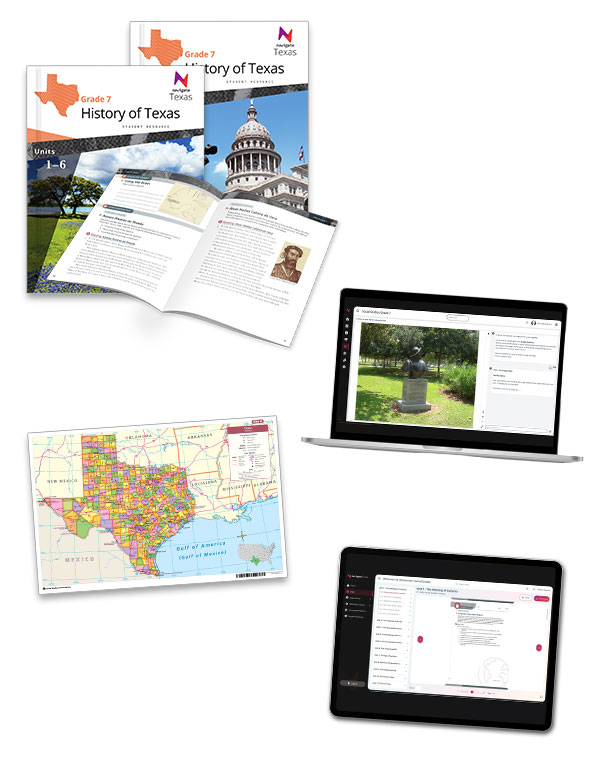
Navigate-TX-G7-Program
Social Studies Grade 7

Texas History

Grade 7 students examine Texas history, beginning with the natural Texas environment through contemporary Texas. Students use reading, writing, and discourse as they explore key concepts, events, and people related to Texas history.

The course was developed through the lens of decision-making questions. Throughout each unit, students interact with a specific question to acquire new information, consider options, and arrive at their own decisions.

Grade 7 Topics

Unit 1: Natural Texas: Physical and Human Geography

Unit 2: Exploration and Early Colonization

Unit 3: Mexican National Era: Colonization and the Empresario System

Unit 4: Texas Revolution

Unit 5: The Republic of Texas and Early Statehood

Unit 6: Civil War and Reconstruction

Unit 7: Texas Government

Unit 8: Cotton, Cattle, Railroads and Westward Expansion

Unit 9: Age of Oil

Unit 10: The Great Depression and WWII

Unit 11: Civil Rights and Conservatism

Unit 12: Contemporary Texas
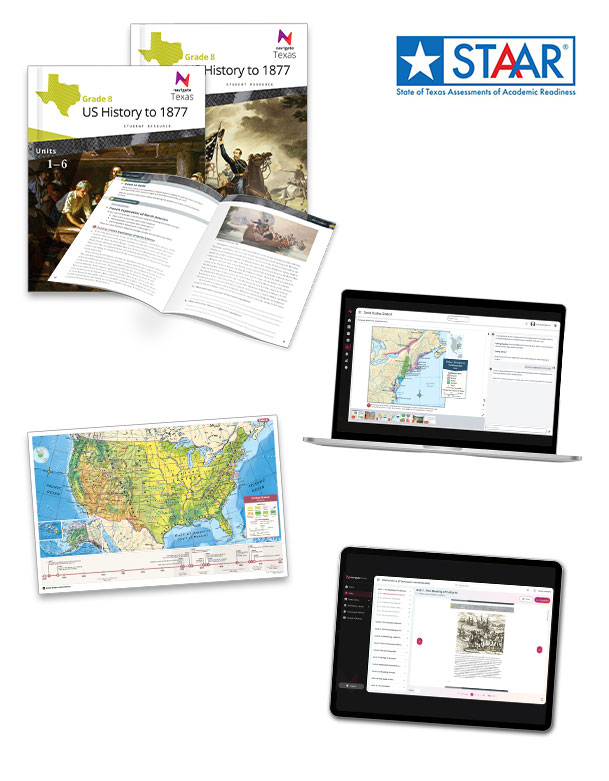
Navigate-TX-G8-Program
Social Studies Grade 8

U.S. History to 1877

Grade 8 students examine U.S. history, beginning with the early Colonial period through Reconstruction. Students use reading, writing, and discourse as they explore key concepts and events related to early U.S. history.

The course was developed through the lens of decision-making questions. Throughout each unit, students interact with a specific question to acquire new information, consider options, and arrive at their own decisions.

Grade 8 Topics

Unit 1: The Meeting of Cultures

Unit 2: The Thirteen Colonies

Unit 3: The Revolutionary Era

Unit 4: Establishing a New Government

Unit 5: The Constitution and Bill of Rights

Unit 6: The Early Republic

Unit 7: Age of Jackson

Unit 8: Westward Expansion and Industrialization

Unit 9: A Changing Society

Unit 10: The Road to War

Unit 11: The Civil War

Unit 12: Reconstruction

Get in touch for a free trial!

Please fill out the form and we’ll be in touch shortly

Elementary

  • Maps: Primary: ELS
  • Maps: Primary: Readiness
  • Maps: Primary: Outline World Map
  • Maps: Intermediate: Physical
  • Maps: Intermediate: Political
  • Maps: Intermediate: Continents and Oceans Thematic
  • Maps: Intermediate: Wealth of Countries Thematic
  • Maps: Intermediate: Precipitation Thematic
  • Maps: Intermediate: Temperature Thematic
  • Maps: Intermediate: Time Zones Thematic
  • Maps: Intermediate: Land Use Thematic
  • Maps: Intermediate: Population Thematic
  • Maps: Intermediate: Outline World Map
  • U.S. History:1 Native Americans
  • U.S. History:2 Spanish Explorers
  • U.S. History:3 Explorers
  • U.S. History:4 The Great Exchange
  • U.S. History:5 European Settlements
  • U.S. History:6 Thirteen Britishi Colonies
  • U.S. History:7 Slevery In the Americas
  • U.S. History:8 Revolutionary War
  • State Map

Secondary

  • Maps: Intermediate: Physical
  • Maps: Intermediate: Political
  • Maps: Intermediate: Continents and Oceans Thematic
  • Maps: Intermediate: Wealth of Countries Thematic
  • Maps: Intermediate: Precipitation Thematic
  • Maps: Intermediate: Temperature Thematic
  • Maps: Intermediate: Time Zones Thematic
  • Maps: Intermediate: Land Use Thematic
  • Maps: Intermediate: Population Thematic
  • Maps: Intermediate: Outline World Map
  • Maps: Secondary: Land Use Thematic
  • Maps: Secondary: Population Thematic
  • Maps: Secondary: Political Relief
  • Maps: Secondary: Land Cover
  • Maps: Secondary: Scupltural Relief
  • Maps: Secondary: Growing Seasons Thematic
  • Maps: Secondary: Climate Thematic
  • Maps: Secondary: Tectonic Plates Thematic
  • Maps: Secondary: Precipitation Thematic
  • Maps: Secondary: Outline World Map
  • State Map

U.S. History

  • Native Americans
  • Spanish Explorers
  • Explorers
  • The Great Exchange
  • European Settlements
  • Thirteen British Colonies
  • Slavery in the Americas
  • Revolutionary War
  • American Expansion
  • Explorations of the West
  • Trails West
  • War with Mexico
  • Slavery Divides the Nation
  • Slavery and the Economy
  • Union and Confederacy
  • Civil War
  • Conflicts with Indians
  • Railroads Tansform the West
  • Industrial United States
  • Immigrants 1895–1929
  • World War I in Europe
  • Great Depression and Dust Bowl
  • World War II in Europe 1939–1942
  • World War II in the Pacific 1941–1945
  • Great Migration 1940–1970
  • Korean War
  • Cold War
  • Vietnam War
  • Persian Gulf War
  • A Shifting Population
  • Immigrants Sinve 1970

World History

  • New Babylonian Empire
  • Ancient Egypt
  • Chinese Dynasties
  • Ancient India
  • Athens and Sparta
  • Alexander’s Empire
  • Roman Empire
  • Barbarians and the Roman Empire
  • Silk Road and Eurasian Trade
  • Byzantine Empire
  • Charlemagne’s Frankish Empire and the Holy Roman Empire
  • Spread of Islam
  • World of the Crusades
  • China in the Middle Ages
  • Mongol Conquest
  • Rise and Fall of Shogun Japan
  • Exploration
  • Maya, Aztec, and Inca
  • European Exploration and Land Claims
  • African Empires and States
  • Rise of Ottoman Empire
  • Reformation and Counter Reformation
  • European Trading Empires
  • Rise and Fall of Mughal Empires
  • Independence in the Americas
  • Napoleon’s Europe
  • Europe After the Congress of Vienna
  • Africa Under Foreign Rule
  • World War I
  • World War II
  • Cold War
  • World Conflicts Since 1991

Texas

  • Spanish Explorers
  • Western Explorations
  • Trails West
  • War with Mexico
  • Indian Wars
  • Railroads & The West
  • Great Migration
  • population Loss and Growth
  • Native Americans in TX
  • Spanish Settlements
  • Republic of Texas
  • Energy Resources of TX
  • Texas Readiness Map
  • Texas Desk Map
  • Texas State Map