
Students Take the Lead with Investigate
A game changer for high school social studies.
Investigate U.S. History & World History
Built from standards. Designed for clarity.
Investigate delivers rigorous, standards-aligned lessons that use purposeful strategies to help students read, write, think, and communicate at a high level. It gives students room to grow and the skills to question the world, and it gives teachers the tools they need to teach their best Tier 1 lesson the first time.
A Roadmap for High-Quality Instruction
Units are built on social studies standards and designed to elevate instruction. Leaders gain visibility and coherence; teachers gain ready-to-teach lessons that support purposeful prep; and students engage in content that challenges them to think, compare, analyze, and problem-solve. Investigate is more than curriculum, it’s a roadmap for high-quality instruction.

A Lesson Structure Designed for Real Learning
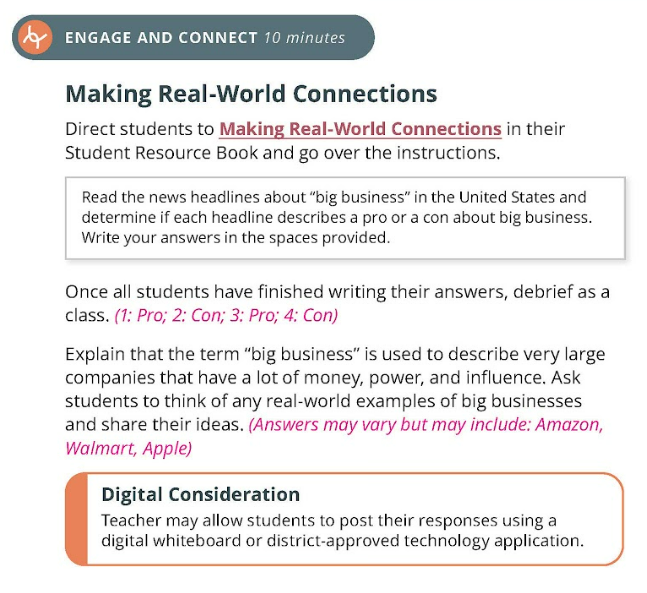
Each course includes 12 units and 72 Tier 1 lessons that follow a clear and consistent format:
- Engage & Connect
- Deliver New Content
- Assess Student Mastery
- Close the Lesson
This intentional design reduces prep time, supports coherent instruction across classrooms, and keeps students focused on what matters most.
Within each lesson, Investigate embeds powerful strategies—Primary Source Analysis, Mapping History, Purposeful Reading, Mini-Inquiry, Authentic Writing, and more. These aren’t extras; they’re built into the lesson so students actively read, write, listen, speak, and think every day.
Students Own Their Learning
Students highlight, annotate, and organize their thinking—all in one place. The platform is built for interaction, empowering high schoolers to engage actively with content instead of simply reading it. Students interact with:
- Lesson-related texts
- Historical and contemporary visuals
- A variety of detailed maps and charts
- Graphic organizers and authentic assessments
At the end of every unit, Investigative Projects give students opportunities to apply their knowledge. Students take on real-world roles—researchers, analysts, and decision-makers—to connect history to today and build a portfolio of work they’re proud to share.

Consistent instruction. Real growth. Shared success.
Assessment & Leadership Support
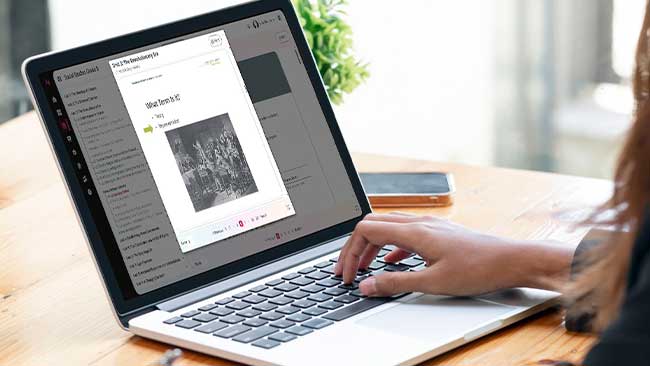
Assessment in Investigate is designed to support growth. Authentic checks for understanding are embedded within lessons and unit-level projects, so teachers can see what students know and adjust in real time.
With the assessment system, educators can easily build formative and summative assessments using a searchable bank of 500 items.
Leaders will appreciate Investigate’s consistent lesson design and embedded strategies, which offer a common playbook for walkthroughs and coaching—supporting coherence across schools while preserving teacher voice and choice.
Frequently Asked Questions
Investigate delivers rigorous, standards-aligned instruction while empowering teachers to lead purposeful lessons and students to take ownership of their learning. Choose from two complete courses:
Investigate U.S. History: 1877 to Present
Investigate World History: Early Civilizations to Present
Each course is composed of 72 lessons across 12 units of study. Each unit also contains an Investigate Project. Every lesson follows the same structure: Engage and Connect, Deliver New Content, Assess Student Mastery, Close the Lesson. The strategies within each lesson are specific to the content within that lesson.
Investigative Projects are real-world, role-based experiences that cap every unit, giving students the chance to apply their learning—not just recall it. Drawing on the unit’s learning objectives, each project asks students to step into an authentic role, investigate a scenario, and create original work that demonstrates deep understanding. As students build a portfolio of reports, presentations, and creative products, they strengthen critical thinking, communication, and decision-making skills, building the independence and confidence they’ll need beyond high school.
Yes. With the 5-day free trial, you can explore full Investigate U.S. History and World History units, view sample lessons, and see how student materials, teacher guidance, and assessments work together. It’s a great way to answer, “What does this actually look like with my students?” before you make any decisions.
If you want more time exploring the free trial, reach out to us at sales@socialstudies.com or 800-421-4246.
Assessment is built into Investigate from the ground up. Teachers get:
Authentic checks for understanding and formative tasks embedded within daily lessons
Unit-level Investigative Projects that ask students to apply knowledge and skills in real-world roles
A searchable bank of 500 assessment items that can be used for do-nows, exit tickets, practice quizzes, and semester or benchmark assessments.
Investigate integrates seamlessly with LMS solutions such as Schoology, Canvas, and others. We also support rostering through ClassLink and One Roster and single sign-on (SSO) through Canvas, Clever, ClassLink, and others.
Have more questions?
We have answers!